


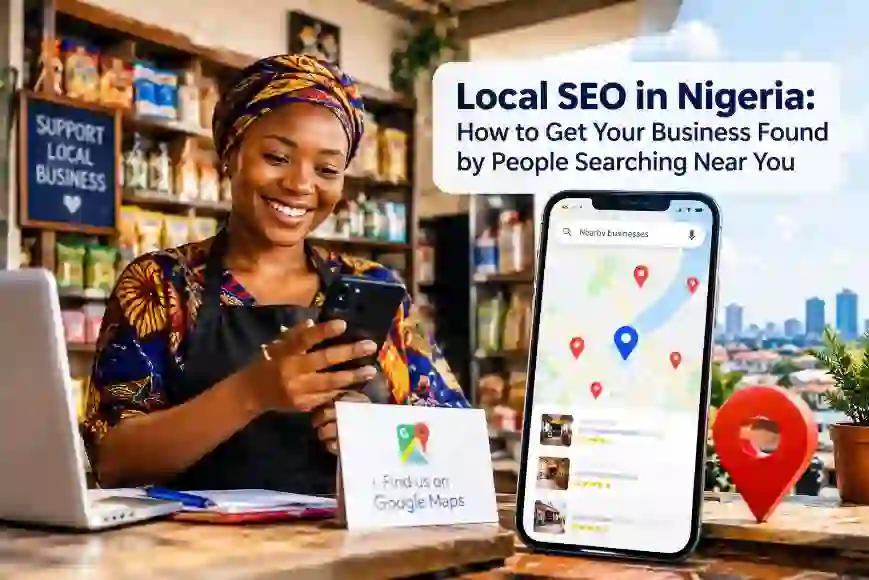
Imagine someone in Lagos searching Google for a tailor near me. Another person in Abuja is looking for a reliable plumber. Meanwhile, someone in Port Harcourt wants to find a restaurant nearby.
Google displays businesses that match these searches. But what happens when your business offers exactly what these customers need, yet your name never appears?
This is where Local SEO in Nigeria becomes important. Local SEO helps your business become more visible on Google Search and Google Maps when people look for products or services in their area. It connects your business with potential customers who are already searching for what you offer.
Whether you own a supermarket in Lagos, a fashion store in Abuja, a restaurant in Enugu or a plumbing business in Ibadan, local search engine optimisation can help more people discover your business online.
In this guide, you will learn what local SEO means, how it works, how to optimise your Google Business Profile and how to attract more local customers without depending entirely on paid advertising.
What Is Local SEO in Nigeria?
Local SEO (Local Search Engine Optimisation) is the process of improving your business’s visibility in location-based searches on search engines such as Google.
In simple terms, it helps people find your business when they search for products or services in a particular location.
For example, someone might search for:
- Supermarket near me.
- Best fashion store in Lagos.
- Restaurants in Lekki.
- Hair salon in Abuja.
- Plumber near me.
- Digital marketing agency in Nigeria.
These are examples of local search queries. People using them often want to find a nearby business, contact a service provider or make a purchase.
Unlike general SEO, which can target audiences across different locations, local SEO focuses on geographical relevance and attracting customers within your service area.
How Does Local SEO Work?
Google considers three main factors when determining local search rankings:
1. Relevance: How closely your business profile matches what someone is searching for.
2. Distance: How far your business is from the person searching or the location mentioned in the search.
3. Prominence: How well-known your business is, including information such as reviews and links from other websites.
Understanding these factors helps you build a stronger local SEO strategy.
Why Is Local SEO in Nigeria Important for Your Business?
More customers use search engines to discover businesses, compare services and find nearby providers.
If your business does not have a strong online presence, potential customers may discover your competitors instead.
Here are some reasons local SEO matters.
1. It Helps Customers Find Your Business
When someone searches for a product or service in your area, an optimised business profile and website can improve your chances of appearing in relevant results.
2. It Attracts Customers With Buying Intent
Consider someone searching for “cake shop near me”. This person may already be looking for somewhere to buy a cake.
Appearing in relevant searches gives your business an opportunity to reach that customer at the right time.
3. It Builds Trust and Credibility
Customers often check business reviews, photographs, addresses and contact information before making decisions.
A complete and accurate online presence makes it easier for people to understand your business.
4. It Supports Small Business Growth
You do not need to operate a large company to benefit from local SEO.
Small businesses, independent professionals and growing brands can improve their online visibility by implementing practical search engine optimisation techniques.
How to Improve Local SEO in Nigeria: 8 Practical Strategies
Getting your business discovered on Google requires more than creating a website or opening a social media account. You need a consistent strategy that helps Google understand your business and helps customers trust it.
Here are eight practical ways to improve your local search visibility.
1. Create and Optimise Your Google Business Profile
One of the most important steps in local SEO is creating a Google Business Profile.
Google Business Profile allows eligible businesses to manage how their information appears on Google Search and Google Maps.
To get started:
- Visit https://www.google.com/business/.
- Sign in with your Google account.
- Add your business name.
- Select the most appropriate business category.
- Enter your business address or service area, where applicable.
- Add your phone number and website.
- Provide accurate opening hours.
- Complete Google’s verification process.
Do not stop after creating your profile.
Add quality photographs, describe your services, update your opening hours and respond to customer reviews.
Grandma Mgbeorie’s example:
Imagine Grandma Mgbeorie owns a grocery shop in Ikeja, Lagos. Customers nearby search Google for “grocery shop in Ikeja”.
However, Grandma Mgbeorie has never created a Google Business Profile.
Google has limited information about her business. Potential customers may therefore struggle to discover her shop through its local business listings.
By creating and maintaining an accurate profile, she gives Google useful information about her business and makes it easier for nearby customers to find her.
2. Use Local SEO Keywords That Nigerian Customers Search For
Keywords are the words and phrases people enter into search engines when looking for information, products or services.
For effective local SEO, use keywords that combine your services with relevant locations.
For example:
- Fashion store in Lagos.
- Best restaurant in Abuja.
- Bakery in Lekki.
- Plumbing services in Ibadan.
- Digital marketing agency in Nigeria.
- Supermarket near me.
- Women’s clothing store in Port Harcourt.
Include relevant keywords naturally in your website titles, headings, service descriptions, blog posts and page content.
Avoid repeating the same keyword unnecessarily. Your content should sound natural and answer customers’ questions.
3. Optimise Your Website for Local Search
Your website is an important part of your local SEO strategy.
A well-optimised website helps search engines understand what your business offers and the locations you serve.
Make sure your website includes:
- A clear homepage describing your business.
- Detailed product and service pages.
- Accurate business contact information.
- A contact page with relevant location details.
- Mobile-friendly design.
- Fast-loading pages.
- Descriptive page titles and meta descriptions.
For example, if Grandma Mgbeorie sells food storage containers in Lagos, her website should explain what she sells, the benefits of her products, how customers can order and the areas where she delivers.
Do not create misleading location pages for places where you do not operate.
4. Keep Your Business Name, Address and Phone Number Consistent
Your business name, address and phone number are commonly referred to as NAP information.
Consistency matters because customers need reliable information about how to find and contact you.
Imagine Grandma Mgbeorie’s grocery shop appears online with three different addresses.
One directory lists her shop in Ikeja, another lists it in Surulere, while her website shows an old address.
This can confuse customers and make business information less reliable.
Use accurate and consistent business details across your website, Google Business Profile and relevant business directories.
5. Collect Genuine Customer Reviews
Customer reviews help potential buyers understand other people’s experiences with your business.
After completing a successful transaction, politely invite customers to share honest feedback.
For example, Grandma Mgbeorie can ask satisfied customers to review her grocery shop on Google.
When customers leave reviews:
- Thank them for their feedback.
- Respond professionally.
- Address genuine complaints.
- Avoid purchasing fake reviews.
- Never offer rewards in exchange for positive reviews.
Remember, reviews are not just about ratings. They also help customers decide whether they can trust your business.
6. Create Location-Specific Content
Publishing useful content about your business location can help you connect with people searching for local information.
For example, a fashion business in Lagos could publish articles about choosing suitable outfits for local events, while a restaurant in Abuja could discuss its menu, delivery coverage and dining experience.
Grandma Mgbeorie could write a blog post titled “Where to Buy Affordable Food Storage Containers in Ikeja”.
The article could explain the available products, their uses, prices and how customers can place orders.
The goal is to provide genuine local information rather than simply inserting city names into every paragraph.
7. Build Local Citations and Relevant Backlinks
Local citations are online mentions of your business information, particularly your name, address and phone number.
You can build a stronger local presence by listing your business in relevant and trustworthy Nigerian business directories and industry websites.
Backlinks are links from other websites pointing to yours.
For example, a Lagos business association, relevant industry publication or local business partner might link to Grandma Mgbeorie’s website.
Focus on relevant, trustworthy websites. Avoid buying large numbers of low-quality links simply to manipulate rankings.
8. Track Your Local SEO Performance
You cannot improve what you do not measure.
Use tools such as Google Search Console and Google Analytics to understand how people discover and interact with your website.
You can monitor:
- Keywords generating website impressions.
- Organic search clicks.
- Pages attracting visitors.
- Website enquiries.
- Phone calls and customer actions.
- Performance of your Google Business Profile.
Review your results regularly and improve the areas that need attention.
Local SEO Mistakes Nigerian Businesses Should Avoid
Even when businesses understand search engine optimisation, certain mistakes can limit their results.
Avoid these common problems:
- Creating a Google Business Profile with incomplete information.
- Using incorrect addresses or outdated phone numbers.
- Stuffing keywords into website content.
- Buying fake Google reviews.
- Ignoring customer feedback.
- Having a slow or poorly designed mobile website.
- Creating duplicate business profiles.
- Using misleading business locations.
- Ignoring website updates and performance monitoring.
Local SEO is a continuous process. Your business information, website and customer experience should remain accurate and useful.
Is Local SEO Worth It for Small Businesses in Nigeria?
Yes. Local SEO can be valuable for small businesses because it helps them reach people searching for relevant products and services in their geographical areas.
Unlike paid advertising, organic local visibility does not require paying Google for every click.
However, local SEO still requires time, effort and sometimes professional investment. Results are not guaranteed, and businesses may face competition from established companies.
The most effective approach is to combine a well-maintained Google Business Profile, useful website content, genuine customer reviews and consistent business information.
Can You Do Local SEO Yourself or Should You Hire an SEO Agency?
You can handle basic local SEO tasks yourself, especially if you operate a small business.
Creating a Google Business Profile, updating business information, requesting genuine reviews and publishing helpful website content are practical starting points.
However, if your business operates in a competitive market, you may benefit from professional SEO services.
An experienced SEO agency can help with keyword research, technical SEO, website optimisation, local content strategy, competitor analysis and performance tracking.
Before hiring an SEO company in Nigeria, ask about its strategy, reporting process, previous work and realistic expectations.
Final Thoughts: Start Making Your Business Visible With Local SEO in Nigeria
Your potential customers are already searching Google for businesses, products and services around them. The question is whether they can find yours.
Local SEO in Nigeria gives businesses an opportunity to improve their visibility, build customer trust and attract relevant local enquiries.
You do not need to implement every strategy at once. Start by creating your Google Business Profile, researching relevant local keywords, improving your website and collecting genuine customer reviews.
Remember Grandma Mgbeorie. She does not need to open another shop in every neighbourhood to reach more customers. She needs to make it easier for people searching for her products to discover her business.
At Kanelian Digital Marketing, we believe digital marketing should be simple, practical and accessible to everyone.
Your business deserves to be discovered. Start building your local online presence today.
Ready to improve your business visibility on Google? Explore professional SEO and digital marketing strategies with Kanelian Digital Marketing.
Frequently Asked Questions About Local SEO in Nigeria
1. What is Local SEO in Nigeria?
Local SEO in Nigeria is the process of improving a business’s visibility on Google Search and Google Maps so that people searching for products and services in specific Nigerian locations can discover it.
2. How can I get my business on Google Maps in Nigeria?
Create a Google Business Profile, enter your accurate business information, select the correct business category, provide your address or service area and complete Google’s verification process.
3. Is Google Business Profile free in Nigeria?
Yes. Creating and managing a Google Business Profile is free. Eligible businesses can use it to manage their presence on Google Search and Maps.
4. How long does Local SEO take to work?
There is no fixed timeframe. Results depend on your competition, business location, website condition, profile quality and other factors. Some improvements may become visible sooner than others.
5. Can I do Local SEO myself?
Yes. You can start by creating your Google Business Profile, researching local keywords, improving your website, collecting genuine customer reviews and updating your business information.
6. Does Local SEO help small businesses?
Yes. Local SEO can help small businesses improve their online visibility and connect with potential customers searching for relevant products and services nearby.
7. What are the most important Local SEO ranking factors?
Google identifies three main factors: relevance, distance and prominence. These determine how closely a business matches a search, how far away it is and how well-known it is.
8. How do I choose the right Local SEO keywords?
Research the products and services your customers search for. Combine relevant service terms with locations where appropriate. For example, a bakery in Lagos could target phrases such as “bakery in Lagos” and “cake shop in Ikeja”.
9. Do customer reviews improve Local SEO?
Reviews can contribute to your business’s prominence in local search. Genuine customer feedback also helps potential customers evaluate your business. Respond to reviews professionally and never purchase fake feedback.
10. What is the difference between Local SEO and traditional SEO?
Traditional SEO focuses on improving a website’s visibility for relevant searches across different geographical areas. Local SEO focuses on searches with geographical intent and helping customers discover businesses in particular locations.
11. Do I need a website to rank on Google Maps?
A website is not compulsory for creating a Google Business Profile. However, having a well-optimised website can strengthen your online presence and provide additional information about your products and services.
12. How much does Local SEO cost in Nigeria?
The cost depends on the services required, competition, website condition and scope of work. Basic Google Business Profile optimisation can be handled independently, while comprehensive SEO campaigns may require professional investment.
13. Can Local SEO help my business get customers without advertising?
Yes. Local SEO can help your business attract customers through organic search visibility without paying for every click. However, achieving and maintaining visibility requires ongoing work.
14. Why is my business not appearing on Google Maps?
Possible reasons include an unverified profile, incomplete business information, incorrect categories, eligibility issues, policy violations or strong competition. Check your profile status and ensure your information follows Google’s guidelines.
About The Author